
What Is Generative Engine Optimization (GEO)? (And How to Create a GEO Strategy)

Your buyers used to Google everything.
Now they ask ChatGPT. And Perplexity. And whatever Google's AI Overview says at the top of the page.
So when a buyer asks, "What's the best tool for [your exact category]?", the question is simple: does AI mention you?
That's what generative engine optimization (GEO) is all about. Let's break down what it is, how it compares to SEO, and how to build a GEO strategy that gets your brand cited. 👇
Key takeaways
- Generative engine optimization (GEO) is the practice of making your brand and content more likely to be mentioned, cited, and recommended in AI-generated answers.
- GEO builds on SEO. Strong SEO fundamentals still matter, and GEO adds a focus on answer-ready content, authority, and a clear brand entity.
- AI tools favor content that answers specific questions clearly, comes from trusted sources, and belongs to a brand they strongly associate with the topic.
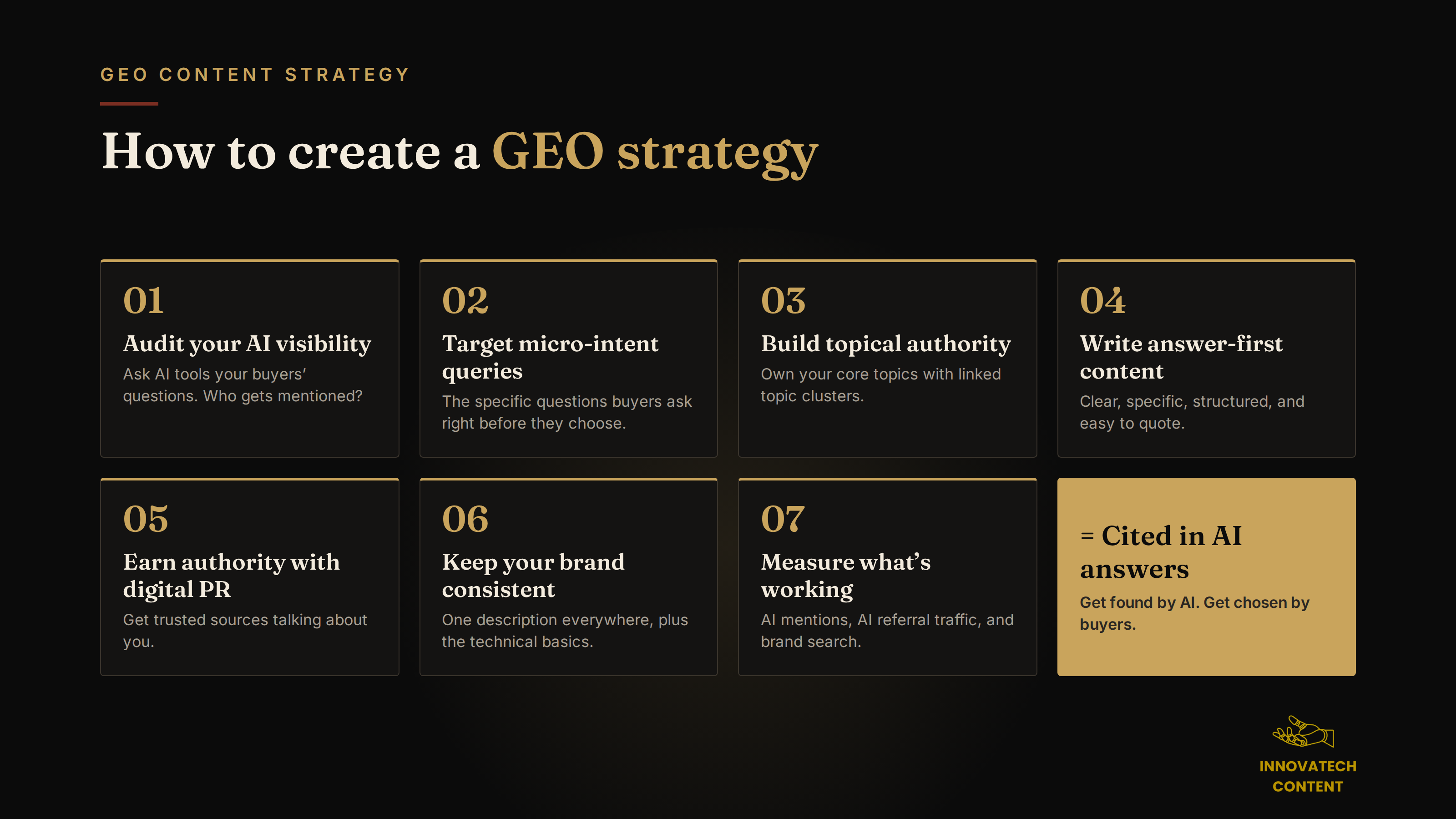
- A GEO strategy has seven parts: audit your AI visibility, target micro-intent queries, build topical authority, write answer-first content, earn authority with digital PR, keep your brand consistent, and measure what's working.
What is generative engine optimization (GEO)?
Generative engine optimization (GEO) is the practice of optimizing your content and brand presence so AI tools like ChatGPT, Perplexity, Gemini, and Google's AI Overviews mention, cite, and recommend you in their answers.
The term took off after a research paper from Princeton and other institutions tested how different content changes affected visibility in AI-generated answers. Since then, it's become one of the hottest topics in content marketing, and for good reason.
With SEO, the goal is ranking. With GEO, the goal is getting included in the answer.
GEO vs. SEO: What's the difference?
GEO and SEO are teammates.
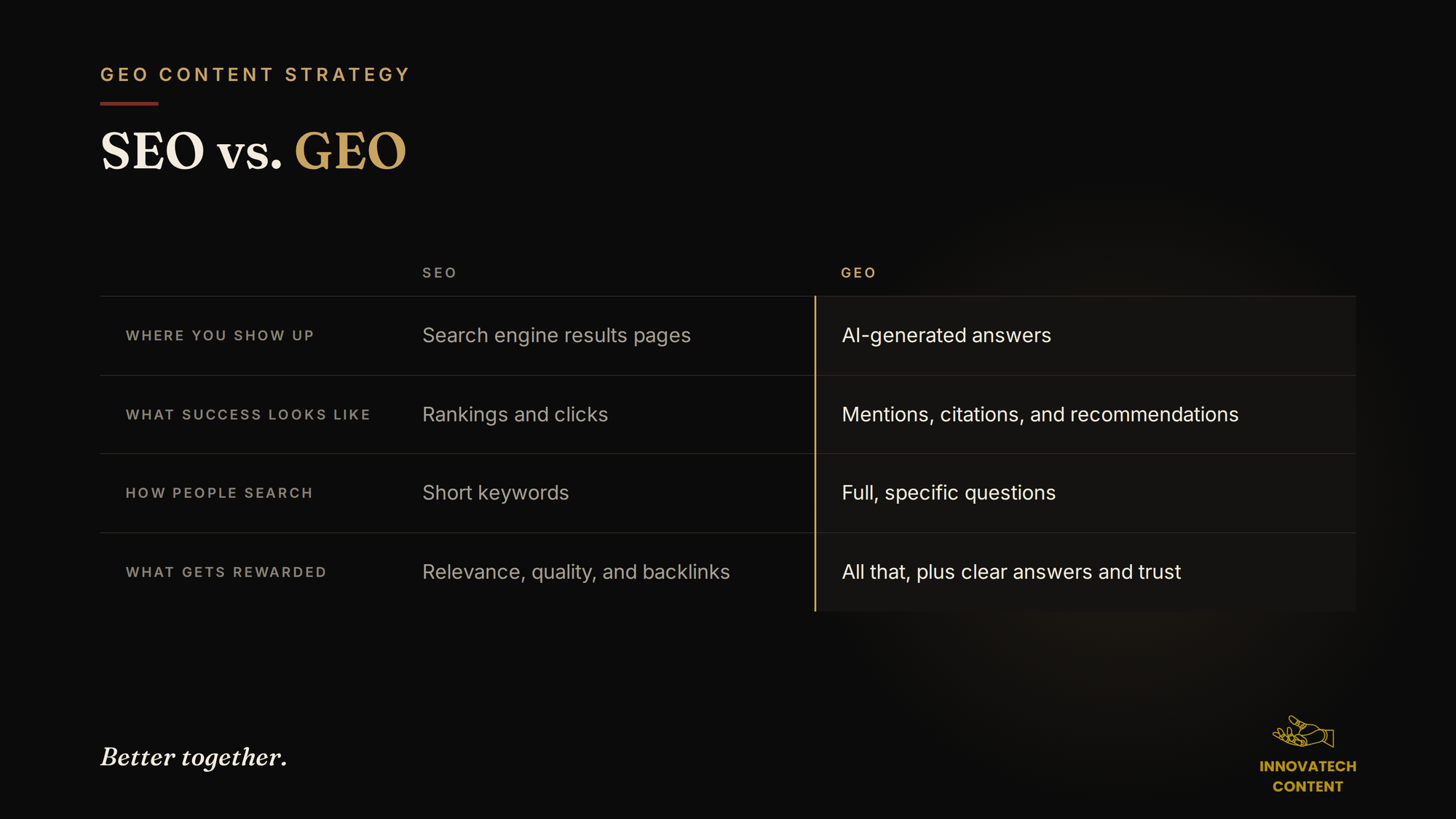
Here's how they compare:
- Where you show up: SEO targets search engine results pages. GEO targets AI-generated answers.
- What success looks like: SEO wins clicks from rankings. GEO wins mentions, citations, and recommendations.
- How people search: SEO often targets short keywords. GEO targets the full, specific questions people ask AI tools.
- What gets rewarded: SEO rewards relevance, quality, and backlinks. GEO rewards all of that, plus clear, quotable answers and a brand AI tools recognize as an authority.
The good news? Most of what makes content great for SEO also makes it great for GEO. Crawlable pages, helpful content, and strong authority still do the heavy lifting.
GEO simply raises the bar on specificity, clarity, and credibility.
How AI tools decide what to cite
Every AI tool works a little differently, but a few patterns show up repeatedly:
1. They break questions into smaller questions. When someone asks a broad question, AI tools often fan it out into narrower sub-questions behind the scenes, then pull answers for each one. Content that answers those specific questions directly has a much better shot at getting included.
2. They lean on trusted sources. AI tools favor sources that show up as credible across the web: brands mentioned by respected publications, experts, and communities.
3. They connect brands to topics. AI tools see your brand as an entity and connect it to the topics you cover. The deeper and more consistent your coverage, the stronger that connection.
4. They like answers they can lift. Clear definitions, concise explanations, specific data, and well-structured pages are easy for AI tools to understand and quote.
How to create a GEO strategy in 7 steps
Ready to get your brand into the answer? 👇
1. Audit your AI visibility
Start by finding out where you stand.
Ask ChatGPT, Perplexity, Gemini, and Google (check the AI Overview) the questions your buyers ask.
For example:
- "What's the best [your category] for [your ideal customer]?"
- "How do I solve [the problem your product solves]?"
- "[Your brand] vs. [top competitor]"
Note which brands get mentioned, which sources get cited, and how AI tools describe you, if they mention you at all.
That's your baseline. Repeat it every month or quarter.
2. Target micro-intent queries
Micro-intent queries are the long, hyper-specific questions buyers ask when they're close to a decision, like "project management tool for a 20-person agency that integrates with HubSpot."
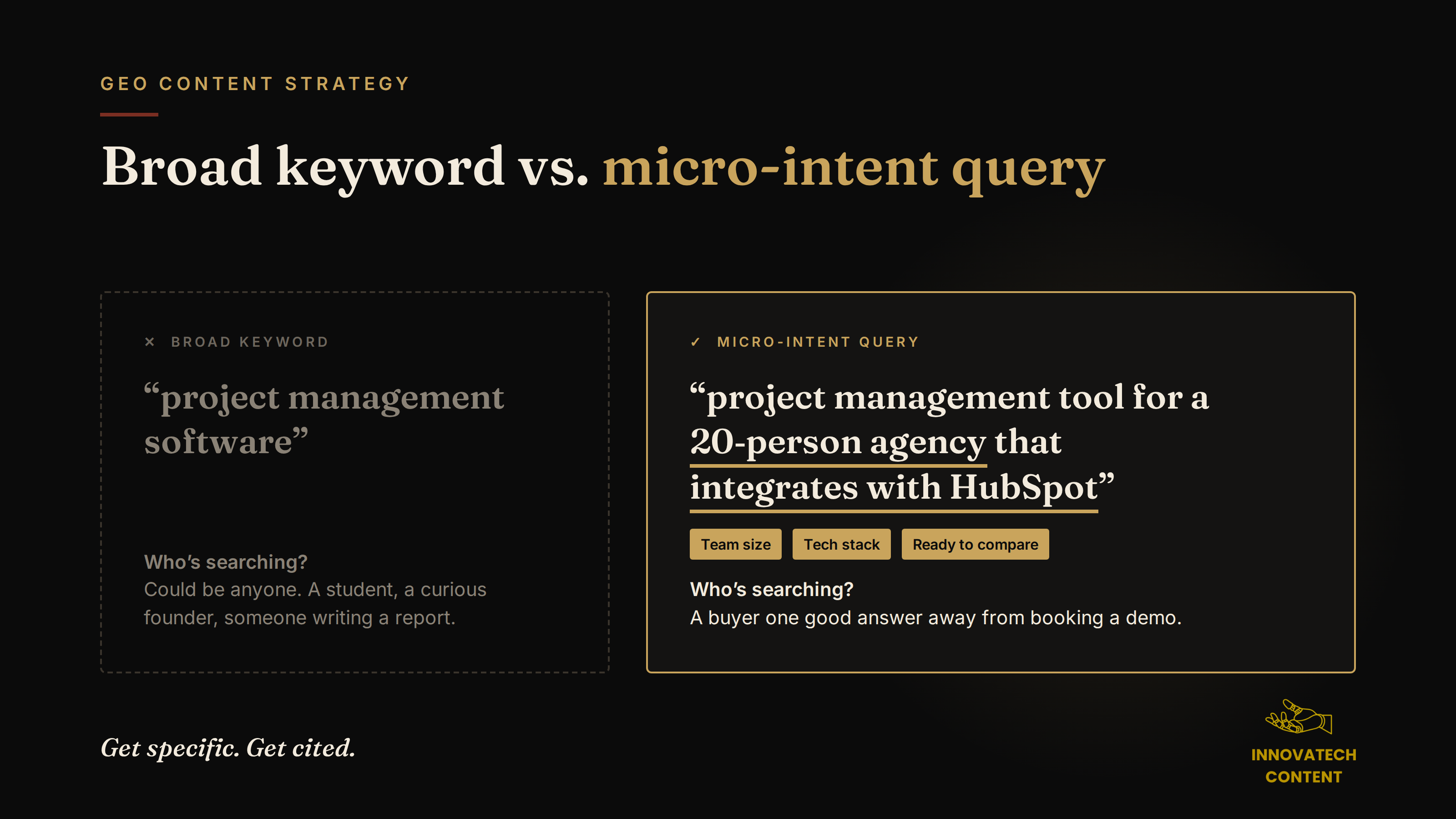
These are exactly the kinds of questions people ask AI tools, and the kinds of sub-questions AI tools go looking for.
Deep dive: Micro-Intent Queries: Your Secret Weapon for GEO Content Strategy
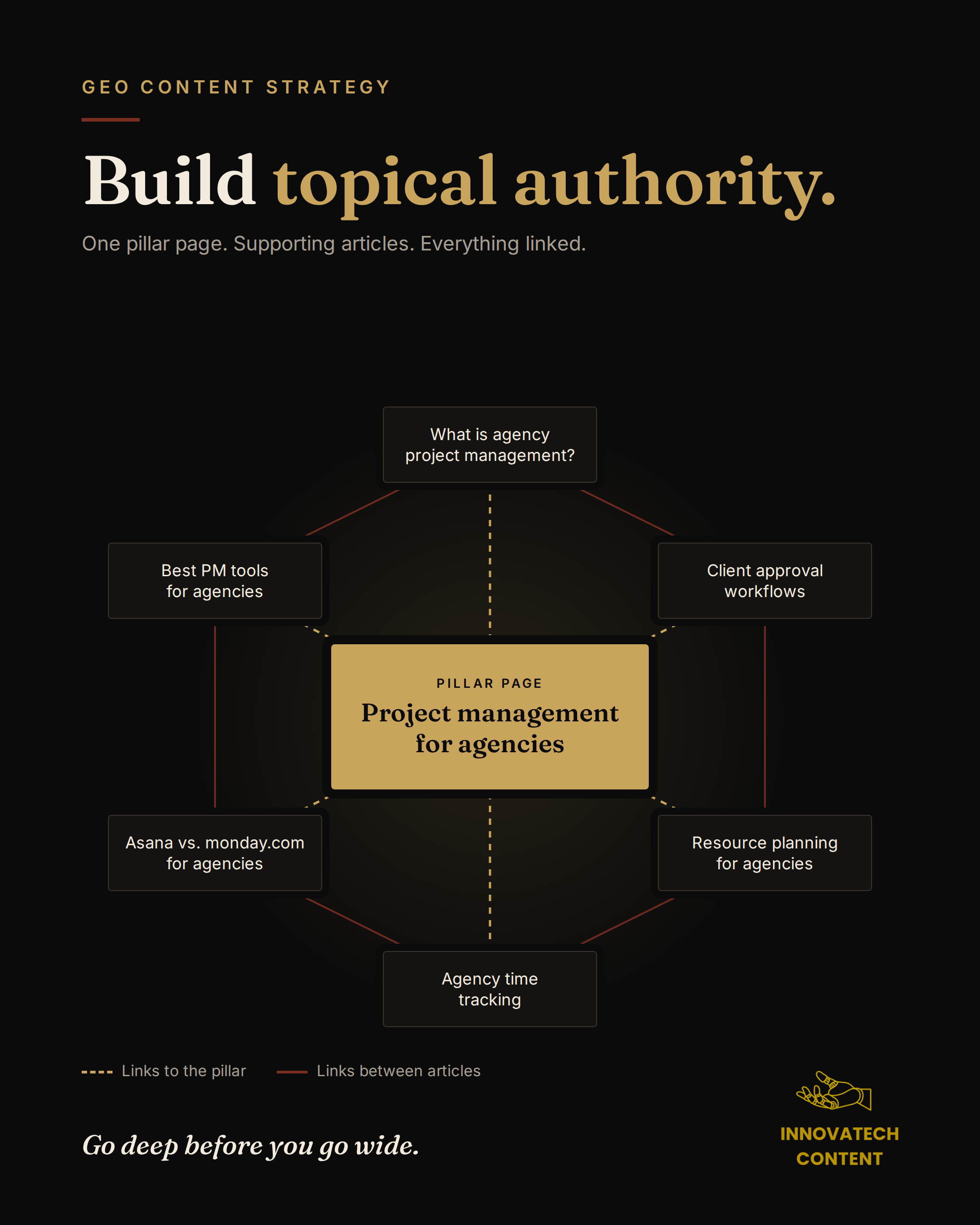
3. Build topical authority
Want AI tools to think of you when someone asks about your category? Own the whole topic.
Pick 1–3 core topics, map every question buyers ask about them, and build topic clusters (a pillar page plus supporting articles, all linked together).
Deep dive: Topical Authority: How to Become the Brand AI Tools Think Of
4. Write answer-first, quotable content
Make the answer to your audience's questions impossible to miss.
For every piece of content:
- Answer the main question in the first few sentences. Then expand.
- Use question-style headings that mirror how people ask.
- Define key terms clearly. A crisp one-sentence definition is easy for AI tools to quote.
- Get specific. Include numbers, examples, use cases, and comparisons.
- Keep it structured. Short paragraphs, lists, tables, and FAQs make your content easier to scan and extract.
- Show your expertise. Add first-hand experience, original insights, and real author bios. E-E-A-T still matters.
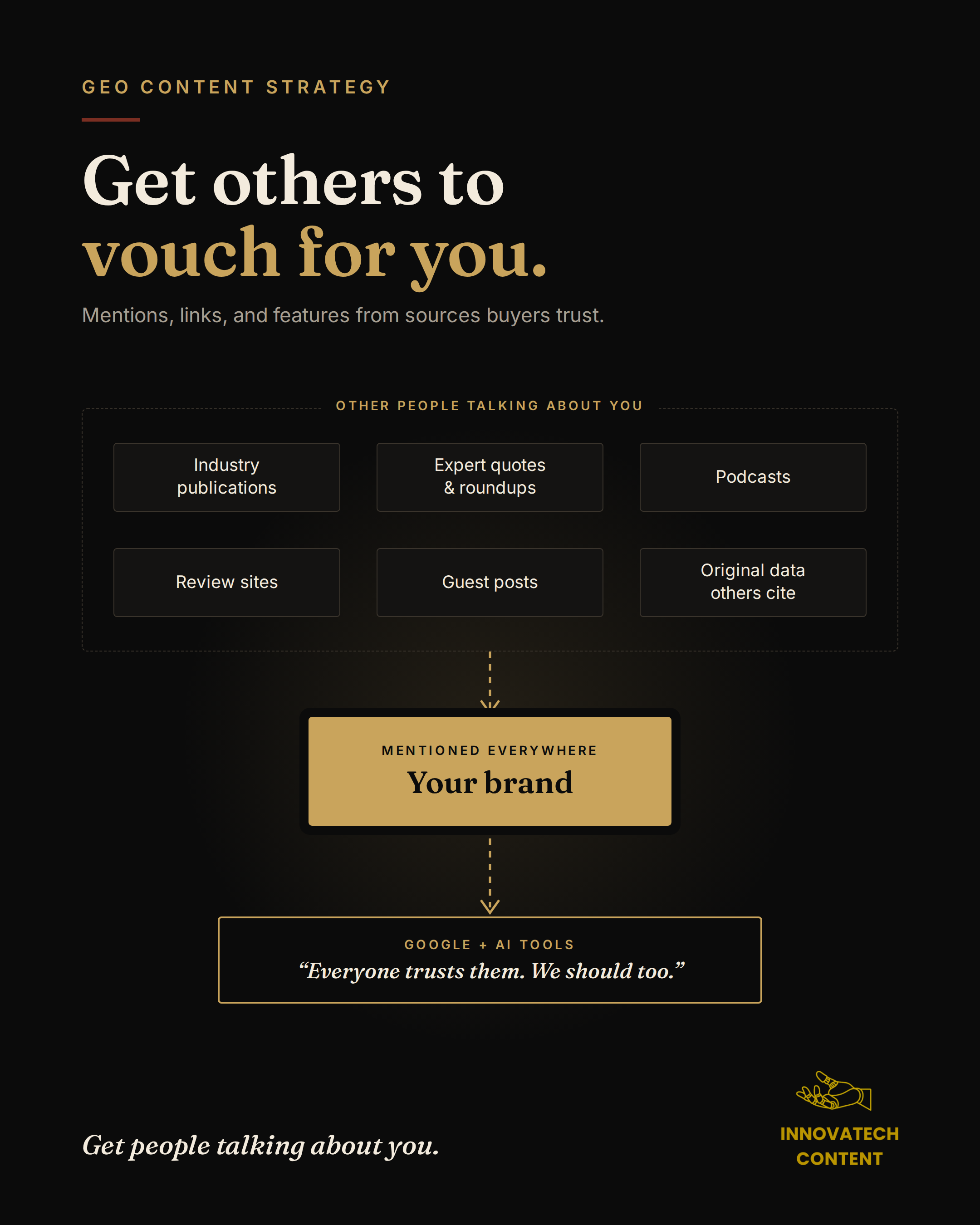
5. Build authority with digital PR
You can publish the most helpful content on the internet. But if nobody else is talking about your brand, AI tools have fewer reasons to trust and mention you.
Digital PR gets other authoritative voices talking about you through original data studies, expert quotes, podcast appearances, guest posts, and newsworthy campaigns. And for GEO, brand mentions can help even without a link.
Deep dive: Why Authority Decides Who Gets Cited in AI Search
6. Describe your brand the same way everywhere
Use the same brand name, the same one-line description of what you do, and the same core topics across your website, LinkedIn, directories like G2 and Crunchbase, author bios, and guest posts.
If your homepage says one thing, your LinkedIn says another, and your G2 profile says a third, AI tools get mixed signals.
Pick one clear description and use it everywhere, so AI tools can confidently connect your brand to your expertise.
While you're at it, check the technical basics:
- Make sure your robots.txt allows AI search crawlers like OAI-SearchBot (ChatGPT) and PerplexityBot, plus Googlebot.
- Keep your key pages fast, crawlable, and free of content hidden behind logins or heavy scripts.
- Add structured data (like Organization, Article, and FAQ schema) where it makes sense.
7. Measure what's working
GEO is still young, so measurement takes a mix of signals:
- AI visibility checks: Rerun your audit prompts regularly and track mentions, citations, and how you're described.
- AI referral traffic: In GA4, look for referral traffic from sources like chatgpt.com and perplexity.ai.
- Brand mentions and referring domains: Track how often trusted sites mention and link to you.
- Branded search: Rising searches for your brand name can signal growing awareness, including from AI answers.
Pro Tip: Ask new leads how they found you. "ChatGPT recommended you" is becoming a more common answer, and it's the best proof there is.
The bottom line on Generative Engine Optimization
Your buyers are asking AI tools for recommendations every day. GEO is how you make sure your brand is part of the answer.
Start with an audit, then build from there: target micro-intent queries, own your core topics, write answer-first content, earn authority, and tell the same brand story everywhere.
Get found by AI. Get chosen by buyers.
Want help building a GEO strategy for your SaaS or tech brand? Book a free strategy call, and we'll show you where your brand shows up in AI search (and where it could).
Agency? We also do white-label SEO, GEO, and content under your brand. Book a partner call.
FAQs about generative engine optimization
Is GEO replacing SEO?
No, GEO builds on SEO. Many AI tools pull from search indexes, so strong SEO still helps you show up in AI answers. GEO adds a sharper focus on answer-ready content, authority, and brand consistency.
What's the difference between GEO, AEO, and LLMO?
They overlap and refer to the same big idea. AEO (answer engine optimization) focuses on getting your content chosen as the direct answer. LLMO (large language model optimization) focuses on visibility in AI models. GEO is the umbrella term most marketers use for optimizing for AI-generated answers.
How long does GEO take to work?
Think months. Answer-first content and technical fixes can show results faster, while topical authority and digital PR build over time.
Do I need to create new content for GEO?
You can start with what you have. Refresh your best pages to answer questions up front, add clear definitions and FAQs, and tighten your structure. Then fill the gaps with new content targeting micro-intent queries.
How do I know if my brand shows up in AI search?
Ask AI tools the questions your buyers ask and see who gets mentioned. Check GA4 for referral traffic from AI tools, and ask new leads how they found you.