
Topical Authority: How to Become the Brand AI Tools Think Of

Want AI tools to think of you when someone asks about your category?
Then you need to own the whole topic.
Welcome to one of the biggest GEO content strategy priorities: building topical authority.
(This post is part of our GEO strategy guide. Catching up? We've covered micro-intent queries and getting other people to vouch for you with digital PR. This one is about proving your expertise on your own website.)
Key takeaways
- Google and AI tools trust brands that cover a topic deeply and consistently. Prioritize topical authority to build clout and align with E-E-A-T.
- Pick 1–3 core topics closest to what you sell, like agency project management for a PM tool built for agencies.
- Map every buyer question across the funnel, from "What is agency project management?" to "Asana vs. monday.com for agencies." Prioritize micro-intent queries (these are the searches your buyers are asking).
- Build topic clusters to demonstrate topical authority. Each cluster includes one pillar page plus supporting articles, all linked together with descriptive anchor text.
- Describe your brand the same way on your website, LinkedIn, G2, and author bios, so AI tools connect your brand to your expertise.
What is topical authority?
Topical authority is how well your content establishes your brand’s expertise on a specific subject.
Search engines and AI tools look beyond individual pages. They see your brand as an entity, a distinct "thing" they know about, and they connect it to the topics you cover.
30 connected posts on your core topic? "Oh, okay, this brand KNOWS project management for agencies."
85 random blogs on irrelevant topics? “Okay, but what do you actually do?”
The more thoroughly and consistently you cover a topic, from the basics to the nitty-gritty comparisons, the stronger that connection gets.
Why topical authority matters for GEO
Topical authority matters for GEO because AI tools need relevant sources to draw from. They look for pages that help answer users' questions.
For example, a brand with a deep, connected resource library for developers gives AI tools plenty to work with. (A brand with one lonely listicle is way harder to spot in the crowd.)
Picture your buyer asking ChatGPT, "What’s the best observability platform for an enterprise engineering team?" Having topical authority can help your brand become part of the answer. From there, they might click through to your site, read comparisons, and check out your reviews on G2, moving one step closer to a sale.
How to build topical authority in 4 steps (a practical checklist)
Follow this checklist to build topical authority in four straightforward steps. 👇
1. Pick 1–3 core topics to build authority in
Choose the topics closest to what you sell, and where you can go deeper than anyone else.
For a project management tool built for agencies, that might be agency project management, client collaboration, and resource planning.
For an HR platform built for remote teams, that might be remote onboarding, global payroll, and employee engagement.
Pro tip: Resist the urge to pick ten. Depth wins here.
2. Map out every question buyers ask
List every question your buyers ask about each topic, across the whole funnel.
For example:
- Top of the funnel: "What is agency project management?"
- Middle of the funnel: "How do agencies handle client approvals?"
- Bottom of the funnel: "Asana vs. monday.com for agencies"
You can find these in:
- Reddit threads and Google's People Also Ask section for your target keywords
- Your sales calls, customer support tickets, and Google Search Console data
- Keyword tools, and by asking ChatGPT and Perplexity yourself.
Highlight the phrases that make the most sense for your target audience and that tie into your solutions.
Target all funnel stages but prioritize the questions that are long-tail micro-intent queries. These are high-intent questions buyers ask when they're comparing or choosing a solution. (So you can get more sales!)
3. Map and build out topic clusters
Take your question list and use it to map out topic clusters.
A topic cluster is a group of linked pages about one main topic, with a parent page (or pillar page) covering the basics and supporting articles (child pages) answering related questions.
Here's what a topic cluster on project management for agencies might look like:
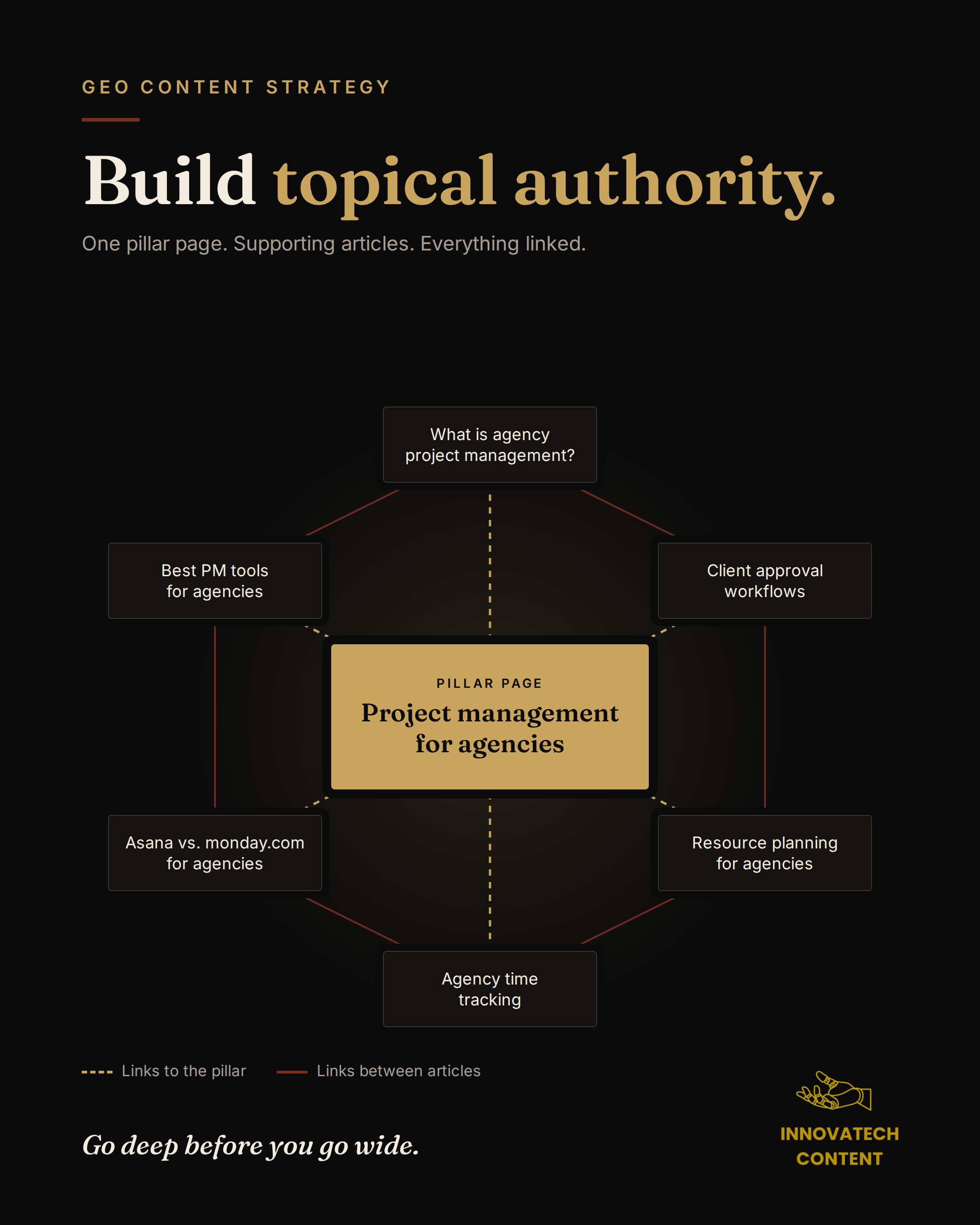
Your pillar page should give a broad overview of one core topic. Each supporting article should go deeper into one specific question.
Then link them all together:
- Link every supporting article back to the pillar page
- Link the pillar page out to every supporting article
- Link related articles to each other using relevant anchor text
Google recommends internal links to help make your content easy to find. Those links also help readers explore your blog, get to know your expertise, and see how your solutions can solve their problems.
For example, in your article on agency time tracking, link the words "resource planning for agencies" to your resource planning article. Those clickable words (your anchor text) tell Google and AI tools what the linked page is about.
4. Describe your brand the same way everywhere
Use the same brand name, one-line description of what you do, and core topics across your website, LinkedIn, directories like G2 and Crunchbase, author bios, and guest posts.
Say your homepage calls you "task management for creative agencies," your LinkedIn says "the all-in-one work OS," and your G2 profile says "team collaboration platform." Those descriptions make your positioning less clear and consistent. (No judgment. We're all guilty of having different titles. 😅)
Pick one description and use it everywhere. For example, "project management software for creative teams." Or "cybersecurity software for healthcare organizations."
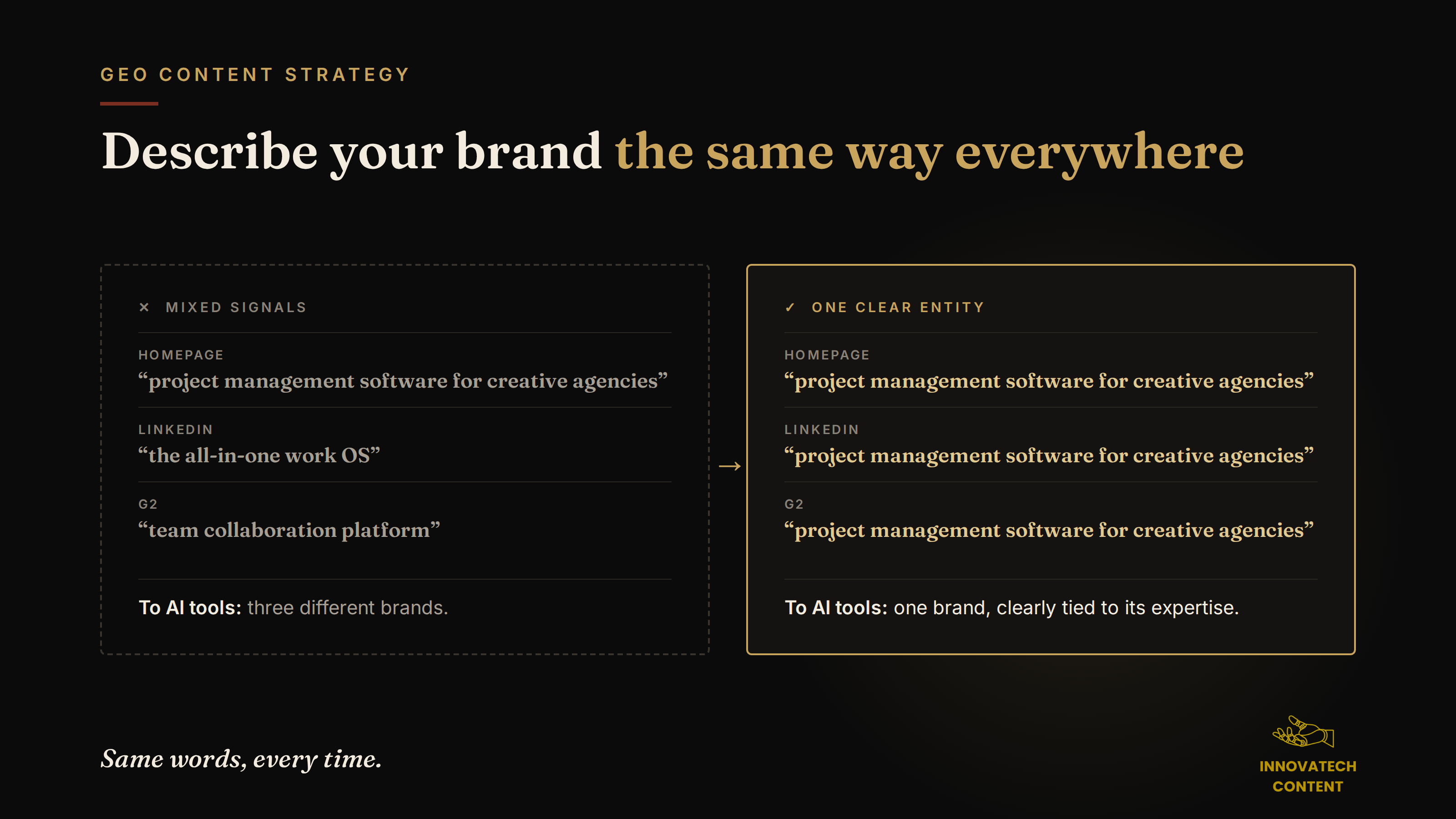
TL;DR: Staying consistent helps AI tools confidently connect your brand entity to your expertise. (A must when you're trying to align your content with E-E-A-T.)
Keep your topic clusters strong
Take care of your topic clusters. Don’t create them, publish them, and then walk away for 18 months. 🙃 Keep them current with fresh data, screenshots, and examples.
Look for gaps, too: what questions are readers asking that you haven’t answered yet?
When updating and strengthening your clusters, make sure to:
- Go all the way. Answer each question fully, with real examples, data, and expert input. Make it actionable with a product walkthrough, an expert explanation, or original research. For a developer audience, that might mean code samples, troubleshooting steps, and comparisons that explain when to use each tool.
- Stick to your core topics. Remember, every new post should strengthen a cluster. The posts in our GEO content strategy series all feed into one another. Each post answers a different buyer question. (If two planned articles would give readers essentially the same answer, I combine them.)
- Check what’s working. Track search impressions, clicks, relevant AI mentions and citations, and visits that lead to demos or inquiries. Look at the cluster as a whole, then use individual page results to decide what needs attention.
- Link every new post. Connect each new article to the pillar and to related articles the day it goes live.
- Refresh regularly. Update your cluster as your product and market change.
🏴 One warning when it comes to refreshes: if it ain't broke, don't fix it. Audit your content and keep what's working. Refresh outdated information and improve weak sections. Unnecessary restructuring can disrupt what’s already working, so I beg you to resist!
The bottom line on topical authority for GEO content strategy
If you remember one thing from this guide, let it be this: go deep before you go wide.
Pick your topics, answer every question about them, link it all together, and tell the same brand story everywhere. With a solid solution and strategic GEO content, you can become the brand AI tools mention and cite.
Want help building topical authority for your SaaS or tech brand? Book a free strategy call.
Run an agency? My team and I write white-label SEO/GEO content, and every draft arrives edited, optimized, and ready for your client, so your editors get their afternoons back. Book a partner call. ✨
FAQs about topical authority
What is a topic cluster?
A topic cluster is one pillar page on a core topic, like "project management for agencies," surrounded by supporting articles that each answer one specific question, like "Agency time tracking" or "Client approval workflows." Everything links together, so Google and AI tools understand what your expertise is in.
How many articles do I need to build topical authority?
To build topical authority, you need enough articles to answer every question your buyers ask about the topic.
I recommend starting with your pillar page and 8–10 supporting articles. Then keep adding more supporting articles as new questions come up in sales calls, support tickets, and search data.
Remember to pick one main topic and relevant sub-topics for each content cluster. See the topical authority checklist above.
How long does it take to build topical authority?
Building topical authority may take a few months, but timing depends on your starting point, competition, and content quality. Google and AI tools need time to find your content, understand how it connects, and start trusting it. (Give the bots time to do their thang.)
Publishing high-quality content consistently can help speed things up.
What's the difference between topical authority and domain authority?
The difference between topical authority and domain authority comes down to what they measure. Domain authority is a third-party score (from Moz, similar to Ahrefs' Domain Rating) based mostly on backlinks. Topical authority is about how thoroughly you cover one subject.