
Micro-Intent Queries: Your Secret Weapon for GEO Content Strategy

If there's one thing to prioritize in your GEO content strategy, it's this: micro-intent queries.
They're the long, hyper-specific searches your best buyers type into Google and ask ChatGPT when they're close to a decision. And in the age of AI search, they're quickly becoming the most valuable real estate in B2B SaaS content.
Let's break down what they are, why they matter so much for GEO (generative engine optimization), and how to find them.
Key takeaways
- Micro-intent queries are long, specific searches that reveal a buyer's exact situation, like their team size, tech stack, or budget. They usually come from people in the middle or bottom of the funnel who are comparing options.
- AI tools often break a broad prompt into narrower sub-questions before answering. Content that answers those specific questions directly is more likely to get pulled in and cited.
- Use sales calls to find the topics buyers care about. Use Search Console, keyword tools, People Also Ask, AI tools, and communities like Reddit to find their exact phrasing.
- Answer the question in the first few sentences, use question-style headings, and get concrete with team sizes, integrations, pricing ranges, and real examples.
What are micro-intent queries?
Micro-intent queries are specific, detailed searches that reveal exactly what someone needs.
Compare these two:
- ❌ "project management software"
- ✅ "project management tool for a 20-person agency that integrates with HubSpot"
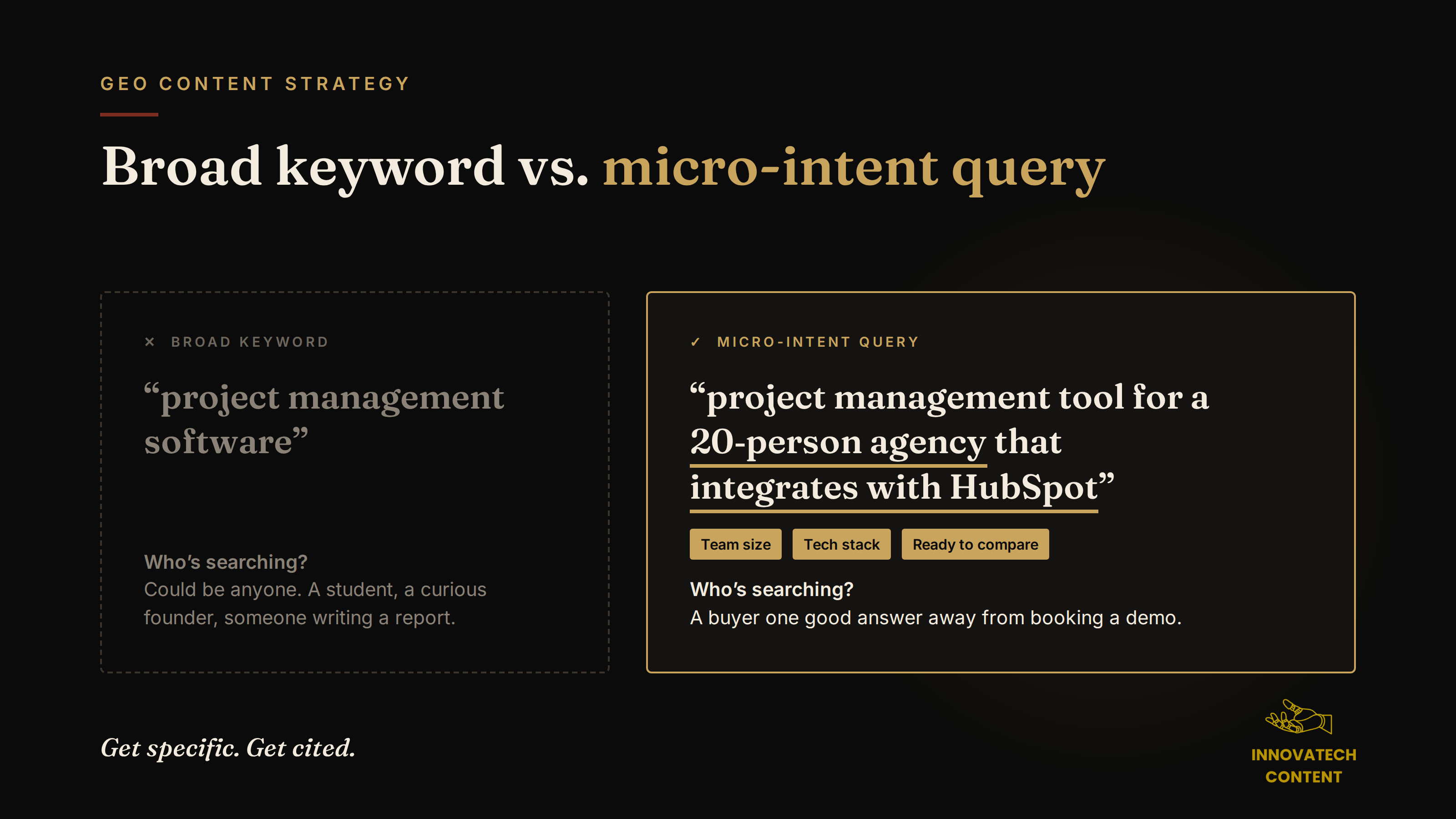
The first one could be anyone. A student, a curious founder, someone writing a school report.
The second one? That person is comparing solutions right meow. 🐾 They know their team size, their tech stack, and what they need. They're one good answer away from booking a demo.
Why micro-intent queries matter even more for AI search
People search differently in AI tools. Instead of typing three keywords, they ask full, specific questions, the same way they'd ask a coworker.
On top of that, AI engines often break a broad prompt into narrower sub-questions behind the scenes before they answer. So when someone asks, "What's the best project management tool for my agency?", the AI might go looking for answers to questions like:
- Which tools work best for small agencies?
- Which tools integrate with HubSpot?
- What do agencies say about pricing?
The content that answers those narrow questions directly and clearly is the content that gets pulled in and cited.
Translation: if your content only targets broad keywords, you're invisible in the moments that matter most.
Why micro-intent queries convert better than broad keywords
Micro-intent queries live in the middle and bottom of the funnel. These are people researching, comparing, and shortlisting.
Look for modifiers like:
- "for [industry or team size]" (CRM for 10-person sales teams)
- "integrates with" (time tracking that integrates with Jira)
- "alternatives" (Trello alternatives for client work)
- "vs." (Asana vs. monday.com for agencies)
- "pricing" (HubSpot pricing for startups)
That's where your ready-to-buy readers hang out.
How to find micro-intent queries
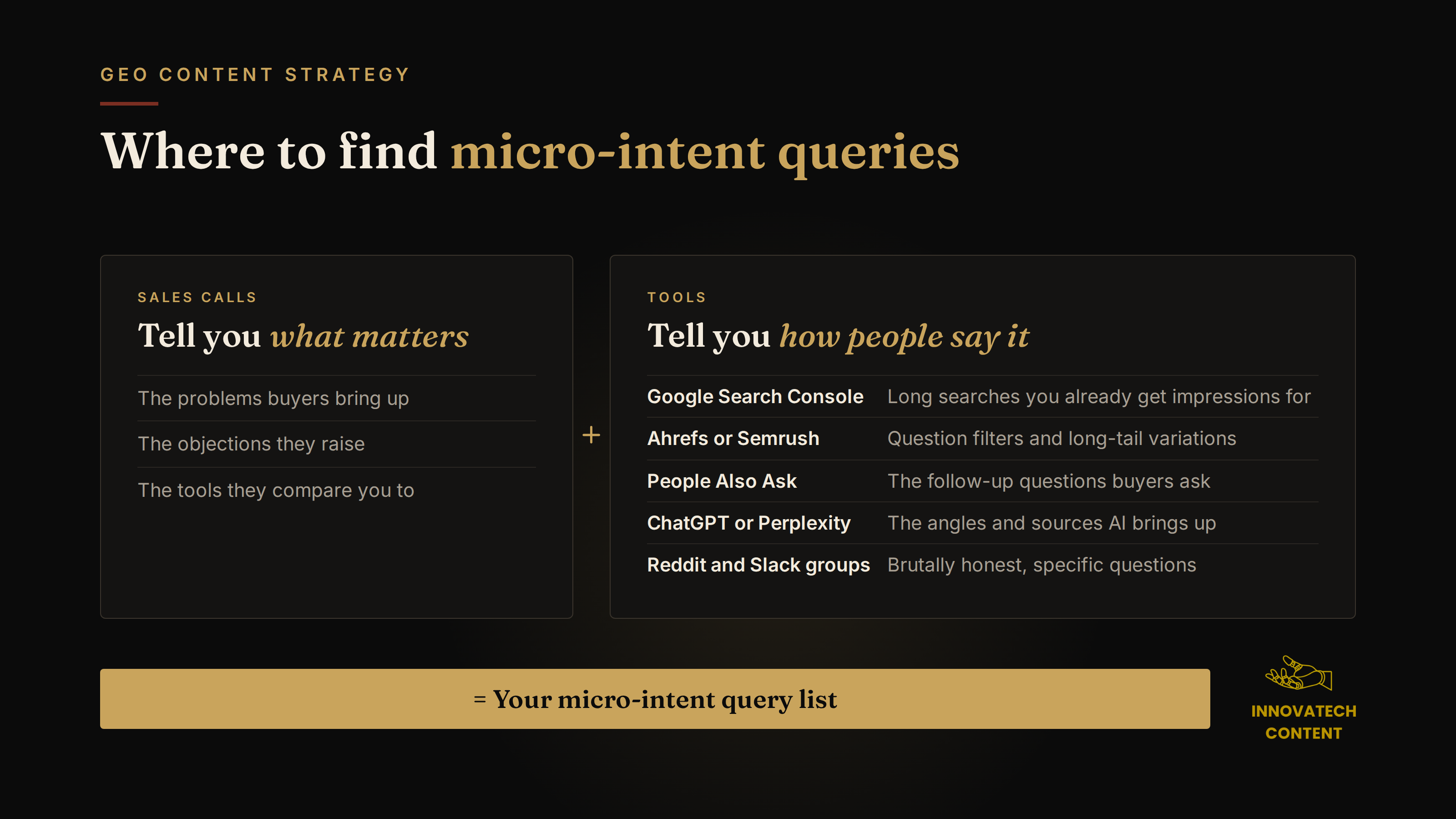
Your sales calls are fantastic for spotting topics: the problems, objections, and comparisons your buyers bring up again and again.
But for the exact phrasing people use, you need tools.
Here's where to look:
- Google Search Console: filter your queries for long, specific searches you're already getting impressions for.
- Keyword tools like Ahrefs or Semrush: use the "questions" filters and look for long-tail variations with clear buying signals.
- People Also Ask boxes and AlsoAsked: great for mapping the follow-up questions buyers ask.
- AI tools themselves: ask ChatGPT or Perplexity a buyer-style question in your niche and note the angles and sources they bring up.
- Communities like Reddit and Slack groups: buyers ask brutally honest, specific questions there.
Combine the two: sales calls tell you what matters, and tools tell you how people say it.
How to target micro-intent queries in your content
Once you've got your list, write content that makes the answer impossible to miss.
For example, if you're writing a blog post:
- Answer the question in the first few sentences. Then expand.
- Use specific, question-style headings that mirror how people ask.
- Get concrete. Include team sizes, integrations, pricing ranges, use cases, real examples.
- Compare honestly. Buyers (and AI tools) trust content that weighs options fairly. Hint: Don't constantly claim that you're the best.
- Keep it structured. Short paragraphs, lists, and tables make your content easier to quote.
Pro tip: Group related queries into topic clusters, so every answer strengthens your authority on the bigger topic. For example, "Asana vs. monday.com for agencies" and "PM tools that integrate with HubSpot" can both link to one pillar page on agency project management.
The bottom line on micro-intent queries for GEO content strategy
Broad keywords still have their place in content strategy.
But if you want to show up when buyers are ready to act, in Google and in AI answers, micro-intent queries are your bread and butter. 🍞🧈
Want help finding and targeting your micro-intent queries? Book a free strategy call, and we'll show you where your brand is showing up (and where it could be).
Agency? We also do white-label SEO, GEO, and content under your brand. Book a partner call.
FAQs about micro-intent queries
What's the difference between a micro-intent query and a long-tail keyword?
The difference between a micro-intent query and a long-tail keyword is what defines them. Long-tail keywords are defined by length and low search volume. Micro-intent queries are defined by intent: they reveal a specific need, like team size, integrations, or budget, and usually come from someone close to buying.
Do micro-intent queries have enough search volume to be worth it?
Micro-intent queries often have small search volume individually, but they're worth it. They attract readers who are ready to act, and they add up. (Targeting lots of specific queries can drive steady, high-intent traffic.)
How do I spot a micro-intent query?
To spot a micro-intent query, look for modifiers that narrow things down. For example, an industry or team size, "integrates with," "alternatives," "vs.," or "pricing." In my experience, they're usually longer than typical keywords and often read like a full question.
Should I still target broad keywords?
Yes, you should still target broad keywords, but don't obsess over them. Broad keywords build awareness, and micro-intent queries target buyers who are usually ready to act.
This post is part of our GEO strategy guide.
Read this next: building authority with digital PR.